Saturday, 28 January 2012

The sea defence diaries (28/01/12) - I should have brought a bigger bucket.

This morning at day break (28/01/12) I targeted the back wall of Margate stone pier from below the lighthouse to the corner of the square head. It was a cold start and it didn't help sinking in a muddy hole up to my knees walking around the square head where it appears the piling has been completed. The area has been well and truly turned over and the ground is very soft as I found out.
The changing of the surface around the square head has now brought fresh debris to the surface where I did manage to find a few coins, but it still needs to wash down to a more solid base to search properly and more methodically .
Once past the square head the ground is more solid and the new piling is clearly visible. The old post 1953 piling has been removed and replaced leaving small piles of debris that have been washed through by the tide leaving plenty of historical evidence amongst the tangled mess of old fishing nets and metal. As customary on these occasions I pick up everything and I was soon to fill up my bucket with bits of brass and copper, plus lead fishing weights and pieces of lead work. All for further examination at a later date, I could have picked up more but the bucket I had was too small so I had to leave some things behind.
In a previous posting I mentioned the Balustrade that surrounded the lighthouse that was constructed in 1829 to replace the 1815 original and how I found two parts of a Baluster . Today I found another piece that know brings my tally to three.
After looking at a few prints I am now convinced that the Balustrade is dated 1815 and not 1829 as I originally thought, confirming that my finds are part of the original construction of the stone pier.
Rummaging through the stone debris from the 1953 storm it is noticeable that there are different types of stone used in the construction of the Stone Pier from the 1810 to 1815 period. Today I came across a large slab of granite, one of many that were used to cap the flat surface of the square head.

I could have done with the tide going out a bit further as there has been some iron concretion dug up but then I thought it can wait as there is so much to see and do at the moment. But I will within the next week give it a whack with a club hammer subject to the tide going out far enough of course.


Thursday, 26 January 2012

The sea defence dig - beach glass

As the Margate sea defence work progress the changes will affect the tidal flow in and around the Harbour and around the Main Sands itself. This in turn will bring many shards and pieces of broken glass to the surface, each piece representing a time period of Margate's 277 years of seaside history. The more dominant pieces being the thick pieces of green aqua glass that are often found worn as smooth as pebbles almost anywhere in the Harbour and Main Sands precinct. Green aqua glass is typical Victorian and is made by adding iron oxide to molten glass in coal fired furnaces that enables a thicker glass bottle to be produced that can hold gaseous liquid like aerated mineral water in a coloured container that can disguise the sediment.
There are many designs of Victorian mineral water bottles, the most famous being the Codd patent mineral water bottle that had an internal marble stopper. That when filled, the pressure in the bottle will push the marble against the internal rubber washer creating a seal. The bottle could then be opened by pressing the marble down and breaking the seal.
These bottles were massed produced and evidence of discarded bottles can be found in every waterway system and coastal area in the country. Margate is no exception and being a Victorian seaside resort the evidence is overwhelming.
In the above photograph are broken necks of a Codd bottle and a marble stopper that show just how the bottle worked, representing some of the many pieces of Codd bottle found in the past few months.
In the bottom left of the photograph is an unusual find of a Lamont patent internal wooden stopper with a rubber seal that I found water logged in Margate Harbour. The principle being that the stopper would float inside the bottle when filled creating a seal.

The sea defence diaries - 26/01/12 a mystery find.

This is the latest find (26/01/12) found by Breheny contractors working on the Margate coastal defence project. Found behind the harbour wall , it certainly is a mystery.
My recent coverage of the sea defence works has certainly been attracting some interest if my blog stats are to be believed. Which is a good thing because it is times like these that someone somewhere may have that little bit of knowledge that can make all the difference and I find it is always best to share things with a wider audience

My theory and it could be totally wrong, is that when passengers boarded or alighted to and from steamers or even when cargoes like coal were being unloaded, or even when the small railway on the upper promenade was in use, there has to be some form of crowd control. I think that this may have been a post or part of a post to hook chains onto, that temporary blocked access. I could be wrong and any other idea will be gratefully received.

Anyway thanks again to Breheny contractors and the team at Margate for taking the time and trouble to save another piece of history.

Tuesday, 24 January 2012

The sea defence diaries 23/01/12 - another find

This piece of the railing sent in by Warren Martin the sea defences site engineer and was found late night on 23/01/12 by Paul Bailey an excavator driver working for Breheny the contractors working on the Margate coastal defence project.

The railing post originally came from the upper promenade around the second and third cant and is one of the original railing posts. From the photograph it confirms this passion Margate Pier and Harbour Company had for painting everything in red oxide that was made of metal and did not move.

The railing post has now been been set aside for exhibition, many thanks to Breheny contractors and the team at Margate.

Monday, 23 January 2012

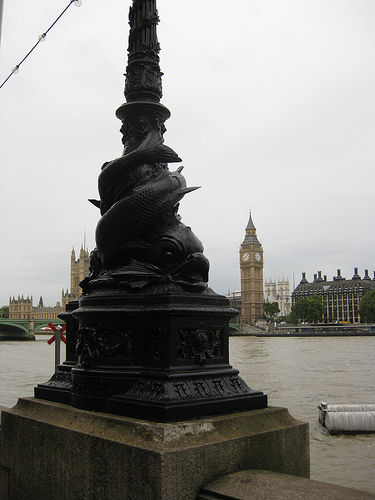
They are Heraldic Dolphins not Sturgeons

When it comes to local history and historical indentification in Thanet there have been many inaccuracies and mistakes often reported and circulated. We all make mistakes and nobody is perfect and like everything else mistakes should be corrected and then just left at that. However, there are some who just keep getting it wrong and and even when presented with the facts still persist on producing the same inaccuracies.
Today I read part of a statement referring to the Margate coastal sea defence works released by TDC and its reads "The Sturgeon lights, which were positioned on top of the concrete pedestals along the sea wall have also been carefully removed".
The facts are that they are not Sturgeons lights but Heraldic Dolphins and this has been pointed out many times.
In fact anyone reading this can check the facts themselves. The photograph from google images to the left is taken of the same lamps along the Thames embankment and they are described as heraldic Dolphins, in fact every reference on google to the design refers to heraldic Dolphins.

So who is right and who is wrong ? - it doesn't take much working out.


Saturday, 21 January 2012

The Margate sea defence dig - animal bones a mystery solved

A few days ago I found an old butchered jaw bone of a pig in Margate Habour, even though it was old and had been in the harbour for many years, it was a find that really did not come as a surprise. This is because finding old animal bones and teeth in Margate Harbour is something I have always done since my bait digging days from the early 1970's. It was only a few months back that I was talking to someone on facebook who remembered finding animal teeth around the slipway area of Margate Harbour.
Putting on my historical cap I was able to tell him that the vicinity around the slipway was once where the old town drain spilled its contents into the harbour and that is most likely the origin of the animal bones and teeth in Margate Harbour.
This afternoon I have been reading up on articles on Horn Corner and Hazardous Row when I can across an article by Mick Twyman. It was one of the last he published before he died and it was a write up he did on Harzardous Row. In a paragraph about the Parade and the bridge that went over the town drain he mentions a wooden hut beside the bridge that can be seen in the copied print on the right of the bridge as you look at it. This wooden hut was in fact a butchers shop and it belonged to a George Penn who was reckoned to have thrown animal remains into the town drain from his shop.
I suppose the evidence is conclusive as in a vicinity where old animal bones and remains are found it just happens to be the outlet of where the old town drain spilled its contents into the harbour and there just happens to be an old butchers shop by that outlet (circa 1790's). Somehow I do not think we will need time team to work that one out.

Anyway I reckon with full confidence that more butchered animal remains will be found when the north wall fronting the Parade is dug and in the Harbour in general.

The sea defence works - recent finds (01/12)

I am now photographing some of my finds, found in the vicinity of the Margate sea defence works to keep as a record. So far I have not come across anything spectacular but I am building a collection of life at Margate Harbour.

This item I believe to be a marine engine part it is made of bronze and weighs over half a kilo found around the square head where pile driving and digging has taken place.


A butchered jaw bone of a pig, I originally thought it was a sheep's jaw but the tusk shape of some of the teeth made me think other otherwise. Found inside the harbour close to the wall where digging and pile driving has taken place.


Three bottlenecks of the string neck variety, the glass is thick and crudely made I reckon probably dates round 1810 to 1830's. These were found on the surface before the sea defence work started when I walked the entire area picking up everything of age.


Clay pipe stems, there is no shortage of them and they are found where any digging has taken place. However, there doesn't seem to be many pipe bowls at the moment.


I think this may be a hand made copper fastening found around the square head of the stone pier. It looks as if it has been subject to a great force that has bent it.


A sample of the hundreds of shards I have picked up over a wide area since the early autumn. Most are non descript and only show signs of age , a few do have part of the logos of paddle steamer companies.